
Top 10 NZ Native Shrubs for Modern Landscaping
Contemporary architecture calls for clean lines, structured planting, and foliage that provides year-round interest without requiring constant upkeep. This is where nz native shrubs truly shine. Adapting perfectly to local conditions, they offer incredible textures—from wiry, zigzagging stems to lush, glossy green leaves—that look incredibly sleek in a modern setting.
If you are planning a garden makeover and want to master modern nz garden design, focusing on foliage and form over bright, fleeting flowers is key. Here is a curated list of the top 10 native shrubs that deliver striking architectural impact while ticking all the boxes for low maintenance native plants nz.
Why Choose NZ Native Shrubs for Modern Landscaping?
When landscaping with native plants nz, you are working with flora that has evolved to withstand our unique, often harsh environments. This means less watering, high resistance to local pests, and resilience against coastal winds. Modern design relies on structural clipping, mass planting, and contrasting textures—all of which New Zealand natives provide effortlessly.
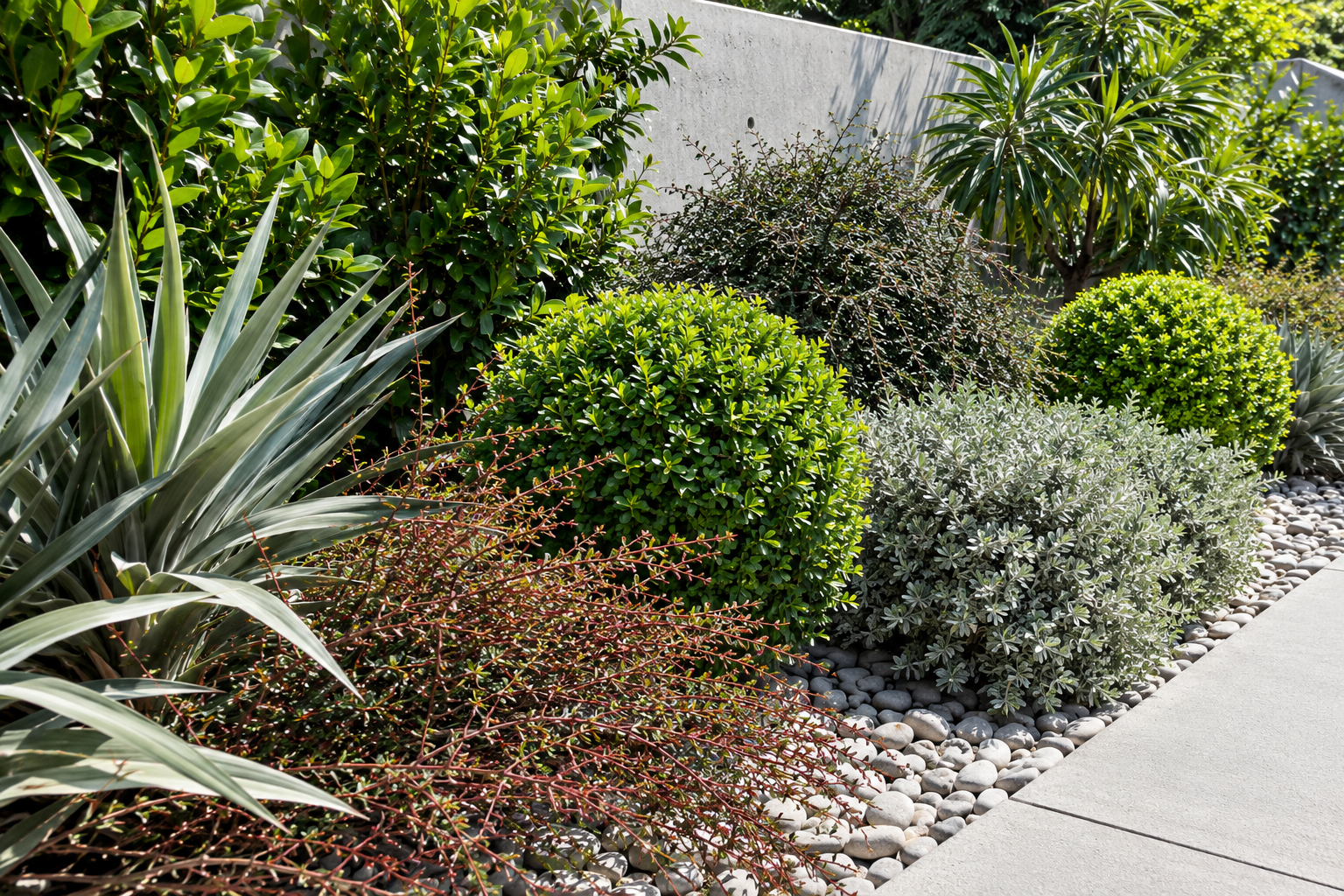
The Top 10 Architectural NZ Native Shrubs
1. Corokia (Corokia cotoneaster and hybrids)
Corokia is the ultimate structural shrub for modern gardens, known for its tangled, wiry branches and silvery-grey or chocolate-toned foliage.
- Best Varieties: ‘Geenty’s Green’ (lush green, excellent for tight hedges) and ‘Frosted Chocolate’ (bronze/brown foliage that contrasts beautifully against white concrete walls).
- Cultural Info: Thrives in full sun to part shade. Highly wind and frost tolerant. Requires excellent drainage and responds brilliantly to regular, tight clipping.
2. Pittosporum (Pittosporum tenuifolium)
While standard Pittosporums can grow into large trees, specific dwarf varieties have been bred to form perfect, dense spheres without the need for constant topiary trimming.
- Best Varieties: ‘Golf Ball’ (naturally grows into a tight, pale green globe) and ‘Stephens Island’ (slightly larger, excellent coastal hardiness).
- Cultural Info: Plant in well-draining soil. They are remarkably fast-growing and look stunning mass-planted in rows or grids in contemporary courtyards.
3. Muehlenbeckia (Muehlenbeckia astonii)
Also known as the shrubby tororaro, this unique plant features completely leafless-looking, reddish-brown wiry zigzag branches that create a striking visual haze.
- Cultural Info: Extremely hardy, drought-resistant, and perfect for coastal or alpine gardens. It is highly architectural and looks fantastic when contrasted against large river stones or smooth paving.
4. Astelia (Astelia chathamica)
Though technically a perennial herbaceous plant, Astelia functions as a structural shrub in modern landscaping. Its long, sword-like metallic silver leaves provide incredible dramatic flair.
- Best Varieties: ‘Silver Spear’.
- Cultural Info: Prefers rich, well-draining soil and looks best when given a bit of afternoon shade in hotter regions. Perfect for underplanting established trees or standing alone in large architectural pots.
5. Coprosma (Coprosma repens)
Known as the mirror bush, Coprosma offers the glossiest leaves in the New Zealand bush. Modern breeders have developed tight, creeping, or mound-forming varieties.
- Best Varieties: ‘Poor Knights’ (a sprawling groundcover/low shrub) and ‘Middlemore’ (a compact, upright shrub with intensely shiny, dark green leaves).
- Cultural Info: One of the toughest coastal plants available. It thrives in poor soil, salt spray, and strong winds.
6. Griselinia (Griselinia littoralis)
If you need a sleek, solid, bright green wall to define a modern space or hide a boundary fence, Griselinia is the undisputed champion.
- Best Varieties: ‘Broadway Mint’ (large, deeply coloured, wavy leaves) and ‘Ardmore Emerald’.
- Cultural Info: Needs good drainage to avoid Phytophthora (root rot). Once established, it forms a dense, lush screen that handles clipping beautifully.
7. Pseudopanax / Houpara (Pseudopanax lessonii)
For a tropical, bold-leaf look that is actually fully native, Houpara provides distinct leathery, lobed leaves.
- Best Varieties: ‘Cyril Watson’ (compact, thick glossy foliage) and ‘Dark Star’ (deep purple-black leaves).
- Cultural Info: Excellent in coastal and frost-free areas. It provides a striking silhouette when up-lit at night with garden lighting.
8. Hebe / Veronica
Hebes provide structure along with the added bonus of structured, geometric flowering spikes. They naturally form neat, rounded bushes.
- Best Varieties: ‘Wiri Cloud’ (compact, rounded with pinkish flowers) and ‘Diosmifolia’ (fine, delicate foliage).
- Cultural Info: Plant in full sun with good airflow. Lightly trim all over immediately after flowering to prevent them from becoming woody and leggy.
9. Red Matipo (Myrsine australis)
A highly underrated shrub for modern design. It features vivid red stems holding undulating, light green leaves, creating a very sophisticated colour palette.
- Cultural Info: Highly adaptable and very hardy. It can be used as a stand-in for Pittosporum where a slightly looser, more naturalistic modern hedge is desired.
10. Brachyglottis (Brachyglottis greyi)
Providing essential contrast to the deep greens of other natives, this spreading shrub offers felt-like, silver-grey foliage with yellow daisy-like flowers in summer.
- Cultural Info: Needs full sun and excellent drainage; it hates wet feet. It is perfect for draping over the edges of modern concrete retaining walls or raised planter boxes.
General Tips for Establishing NZ Native Shrubs
To keep your modern native garden looking pristine, preparation is vital. Most New Zealand natives require excellent drainage. If you are planting into heavy clay, dig a hole twice as wide as the pot and break up the bottom, blending in plenty of compost and pumice to aerate the soil. Apply a thick layer of organic mulch (like bark or woodchip) to suppress weeds and retain summer moisture, keeping the mulch clear of the woody stems to prevent rot. With an annual feed of slow-release native fertiliser and a light, regular clip to maintain their geometric shapes, these shrubs will provide decades of low-maintenance beauty.